

Venue & Program
Venue & Program
CONFERENCE VENUE — Intelligent Robotics FAIR 2026
JUNE 18 - 20 2026, BUDAPEST, HUNGARY
First day
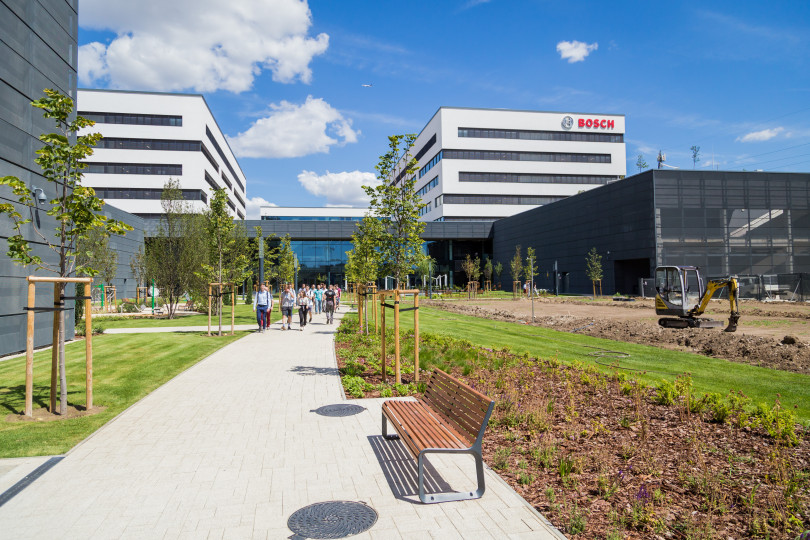
Join us at the intRobFAIR2026 conference. Experience the perfect blend of professional engagement and the vibrant summer life of the capital of Hungary. We look forward to welcoming you!
Venue for the first day: Bosch Budapest Innovation Campus
Address: 1103 Budapest, Robert Bosch street 14. (Previously: 1103 Budapest, Vaspálya street 58.)
The venue is home to the regional headquarters of the Bosch group and the Engineering Center Budapest (ECB). The ECB was founded in 2005 and now has nearly 3600 employees, making Hungary Bosch’s largest R&D location in Europe after Germany in terms of automotive engineers. The ECB plays an important role in the development of automated and electrified mobility. It is also one of the foremost research, development, and test facilities for automotive electronics in the Bosch Group.
Getting to the Bosch Budapest Innovation Campus
The venue is just a few hundred meters away from the Kőbánya-Kispest (KÖKI) metro terminal, allowing easy access from any point in Budapest.
How to Get There:
Public transport:
Take M3 (blue) metro line to Kőbánya-Kispest terminal. You need to buy and validate a ticket, see https://bkk.hu/en/
By car:
Street parking is free of charge but limited. The KöKI Terminál parking lot nearby charges a fee; no access to the Bosch parking lot.
From the airport:
The 200E bus goes directly from the airport to the KöKi terminal with a standard ticket. The 100E line goes downtown for a higher fee. Airport information: https://www.bud.hu/en Taxi and shuttle services are also available from the airport.
Conference access for the first day:
The IntRobFAIR2026 reception will be located under a tent outside the gates, behind the reception building. Laptops will have to be registered with security. Photo, video, or sound recording on-site requires a permit. Official photos will be taken of the event. Approach the photographer if you want your picture taken!
Second and third day
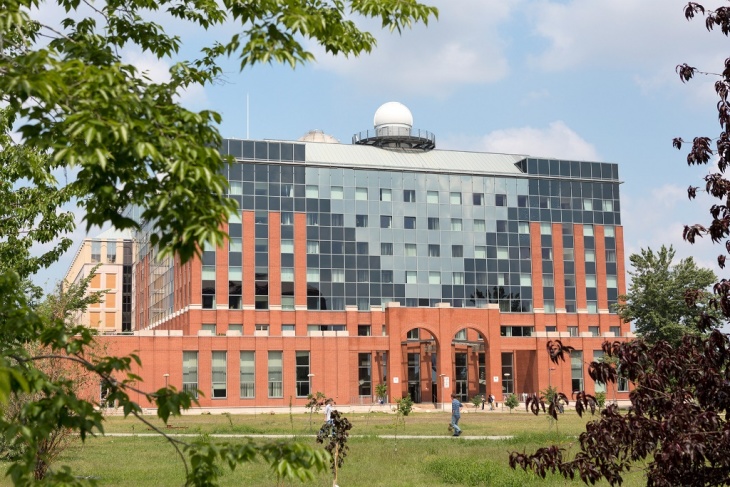
Venue for the second and third day: ELTE Lángymányosi Campus North building
Address: 1117 Budapest, Pázmány Péter sétány 1/A
Founded in 1635, Eötvös Loránd University (ELTE) is one of the oldest and most prestigious institutions of higher education in Hungary and Central Europe. Named after the renowned physicist Loránd Eötvös, the university has a rich academic tradition and a strong emphasis on research and innovation. ELTE consistently ranks among the top universities in Hungary and is widely recognized for its contributions to the humanities, natural sciences, social sciences, and law. The university offers a wide range of undergraduate, graduate, and doctoral programs in both Hungarian and English, attracting students from around the world. ELTE is known for its rigorous academic standards, distinguished faculty, and vibrant intellectual community.
The Lágymányos Campus is one of ELTE’s most modern and dynamic educational hubs, located along the picturesque banks of the Danube River in southern Budapest. It houses two of ELTE’s most prominent faculties: the Faculty of Science and the Faculty of Informatics. This state-of-the-art campus features contemporary architecture, spacious lecture halls, advanced laboratories, and well-equipped research centers. Its green surroundings, riverfront views, and proximity to public transportation make it an ideal environment for both study and leisure. In addition to academic facilities, the Lágymányos Campus fosters a vibrant student life with cafes, student clubs, and cultural events. It also collaborates with various Hungarian and international research institutions, making it a key center for scientific advancement in the region.
How to Get There:
By Public Transport (Recommended)
Budapest has an efficient and well-connected public transportation system operated by BKK (Budapesti Közlekedési Központ). You need to buy and validate a ticket, see https://bkk.hu/en/
-
From the city center (e.g., Deák Ferenc tér):
-
Take Metro Line M4 (green line) toward Kelenföld vasútállomás
-
Get off at Újbuda-központ or Móricz Zsigmond körtér, then walk ~10 minutes to the campus
-
Alternatively, change to tram 1 or tram 6 at Móricz Zsigmond körtér for 1 stop to Petőfi híd, budai hídfő, which is next to the campus
-
-
From Keleti Railway Station:
-
Take Metro Line M4 directly to Újbuda-központ
-
-
From Népliget (international bus terminal):
-
Take Metro Line M3 (blue line) to Kálvin tér, then transfer to Metro Line M4
-
Continue as above
-
From the Airport (Liszt Ferenc International Airport)
-
Take bus 100E to Kálvin tér, then switch to Metro Line M4
-
Travel toward Kelenföld and get off at Újbuda-központ or Móricz Zsigmond körtér
Estimated travel time: ~60 minutes
By Taxi or Rideshare:
Official Budapest taxis (e.g., Főtaxi) are available at the airport and across the city. A typical ride from the airport to the campus takes 30–45 minutes, depending on traffic, and costs around 10,000–12,000 HUF (~25–30 EUR). Always request a receipt and confirm pricing with the driver.
Note: Avoid unlicensed taxis. Rideshare apps like Bolt are also reliable.
By Car:
Paid street parking is available in the area, though it can be limited during working hours. We recommend using public transport whenever possible.
Conference program
18.06.2026
Színházterem (Bosch Budapest Innovation Campus)Registration and Welcome reception
Welcome speeches
Tamás Kozsik & Tamás Fischl
Keynote 1: Trygve Thomessen: Service Robots in Nursing Homes: Urgent Demand and Complex Multidisciplinary Challenges
Chair: János Botzheim
Coffee break
Session 1 - 6 presentations
Chair: János Botzheim
Roundtable talk
Moderator: Barnabás Málnay
Lunch break
Keynote 2: Csilla Csukonyi: Organic Human-Robot Interaction: Psychological Aspects to Help Social Robots Become Sociable Indeed
Chair: János Botzheim
Coffee break
Session 2 - 5 presentations
Chair: Zoltán Istenes
End of the day
19.06.2026
Harmónia terem (ELTE Lágymányos Campus North Building)Registration and welcome reception
Keynote 3: Nicolas Ragot: Exploring Digital Twin Opportunities: Building Hybrid Worlds for Industrial AI
Chair: Kristian Fenech
Session 3 - 6 presentations
Chair: László Gulyás
Coffee break - Globe Hall
Session 4 - 5 presentations
Chair: Tamás Fischl
Lunch break - Globe Hall
Drone show
Coffee break + Networking w. Expo partners - Globe Hall
Session 5 - 5 presentations
Chair: Zoltán Istenes
Conference ending ceremony
János Botzheim
End of the day
Counterfeit Actor-Critic: Learning Contrasting Value Landscapes in Fully Decentralized Cooperative MARL
Benchmarking Open-Source Segmentation and Metric Monocular Depth Methods in 6DoF Object Pose Estimation with FoundationPose
A Framework for Human-Aware Navigation in Quadruped Robots using 3D LiDAR Sensing
Camera/LiDAR Calibration Framework Using Spatial Cosine Similarity Sampler As Objective Function
Figure-Level Substitutability in Scientific Document Summarization
Robust Multi-Camera Visual Odometry in Specular Indoor Environments Using Deep Learning
AIAC: A novel Master's Programme in Artificial Intelligence with Affective Computing
Evaluation of Prompt Techniques for Natural Language Robot Control in Simulated Environments
MAVCG: Model-Assisted Verified Code Generation from ODD Protocols via Dafny Specifications
Targeted Behavioral Unlearning for Discrete On-Policy Reinforcement Learning
When Agents Disappear: Trajectory Prediction Under Sensor Truncation via Dynamic Soft-WTA
Machine Perception-based Box Dimension Measurement with Sensor Fusion for Automated Box Handling Tasks
An Observation-Driven Attachment and Rule-Based Behavior Modeling Framework for Social Robots
Conditional Denoising Diffusion Probabilistic Model with Simplex Noise for Welding Line Anomaly Detection
Distance-based Scan Context
Causal Rule Discovery for Compliance Improvement in Procurement Logs: A Case Study on BPI Challenge
A Camera–LiDAR Fusion Architecture for Owner-Aware Human Tracking in Mobile Robotics
Neural Networks for Temporal Pattern Recognition and Dynamic Arm Gesture Speed Estimation for Robot Control
MiniMARL: An Evaluation-Oriented PyTorch Framework for Rapid Multi-Agent Reinforcement Learning Prototyping
Benchmarking Adversarial Robustness of Graph Neural Networks Under Structural Poisoning Attacks
Biologically Inspired Document Embedding in Discrete Spaces
DepthMeshNeRF: NeRF depth estimates for Point Cloud extraction and Mesh Generation
A Biomimetic Finger with Embedded Force Sensor for Pear Maturity Measurement
Simulation-Driven LiDAR Reinforcement Learning for Obstacle Jumping on the Unitree GO2
A ROS2-Based Human Attention and Emotion Perception Framework for Ethorobotics-Oriented Human-Robot Interaction
Enhancing Low Light Human Detection Robustness for Mobile Robotic Platforms